Introduction
The half diamond pattern is characterized by its diamond-like shape, truncated at the center.
Understanding the Half Diamond Star Pattern
The half diamond star pattern is a visual representation of stars forming a diamond shape but only half of it. The pattern consists of rows of stars, where the number of stars in each row increases or decreases, creating the illusion of a diamond cut in half.
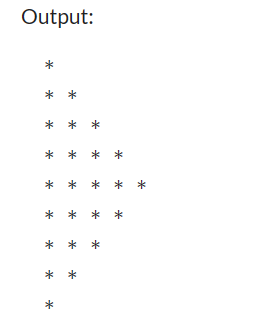
Consider the following example with a height of 5.
*
**
***
****
*****
****
***
**
*
In this pattern, the number of stars increases up to the middle row and then decreases in a symmetrical manner.
Code Implementation
#include <iostream>

int main() {
    int height = 5;

    // Upper half of the diamond
    for (int i = 1; i <= height; ++i) {
        for (int j = 1; j <= i; ++j) {
            std::cout << "* ";
        }
        std::cout << std::endl;
    }

    // Lower half of the diamond
    for (int i = height - 1; i >= 1; --i) {
        for (int j = 1; j <= i; ++j) {
            std::cout << "* ";
        }
        std::cout << std::endl;
    }

    return 0;
}
Explanation
- The first loop (
for (int i = 1; i <= height; ++i)) controls the upper half of the diamond, incrementing the number of stars in each row. - The second loop (
for (int i = height - 1; i >= 1; --i)) controls the lower half of the diamond, decrementing the number of stars in each row. - The inner loop (
for (int j = 1; j <= i; ++j)) in both cases prints the stars in each row. - The
std::endlis used to move to the next line after printing each row.
Complexity Analysis
Time Complexity: The time complexity of generating the half diamond pattern is O(n^2), where n is the height of the diamond. Both the upper and lower halves contribute to the quadratic time complexity.
Space Complexity: The space complexity is O(1), constant, as the amount of memory used does not depend on the input size. The memory required for each iteration remains constant.

Join the discussion
Sign in with your account to post comments, reply to others, and participate in the conversation.
Login to Comment