


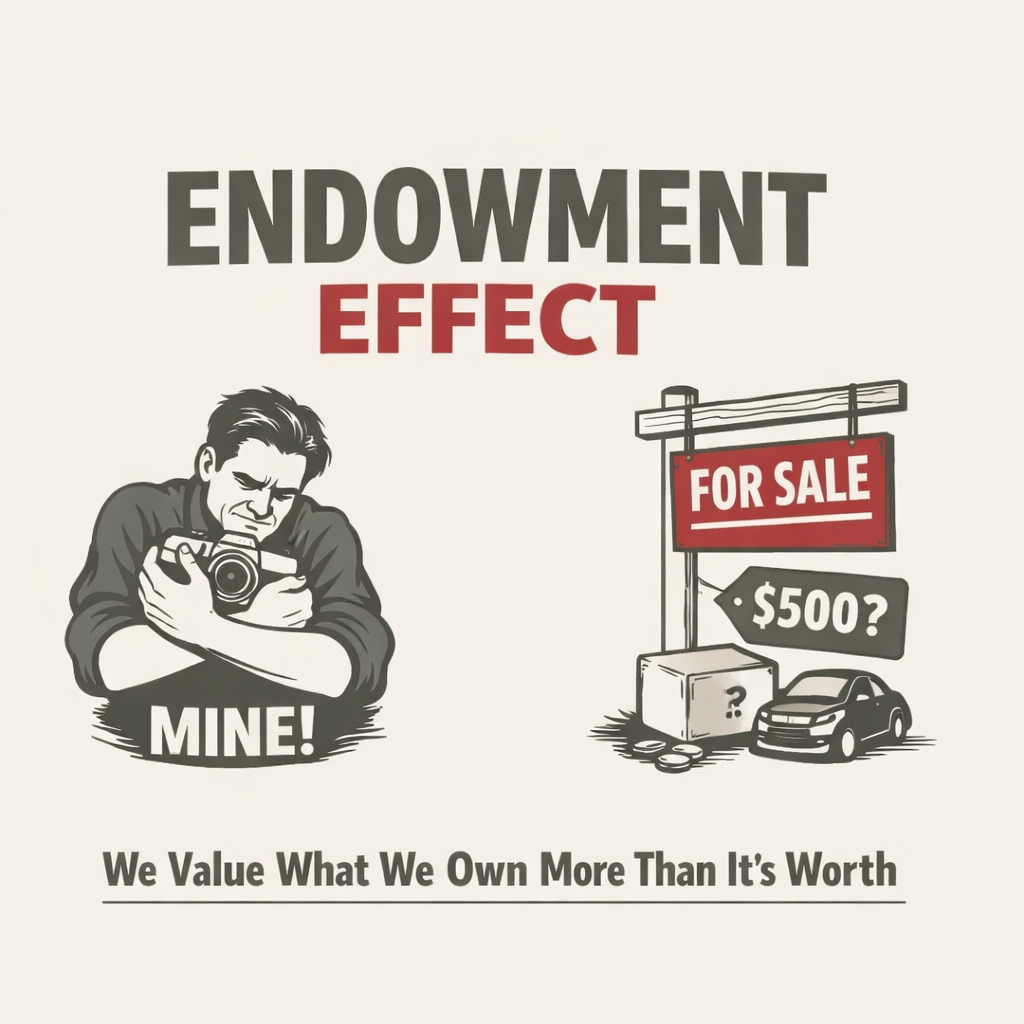
Imagine you're selling your old smartphone.
You believe it's worth $500.
A buyer offers $350.
You immediately think,
"That's way too low."
A week later, you find the exact same phone listed online for $350.
Suddenly, the price seems completely reasonable.
So why did your phone feel more valuable than someone else's?
The answer isn't the phone.
It's the fact that you owned it.
Welcome to the Endowment Effect—a psychological bias that causes us to value things more simply because they belong to us.
What Is the Endowment Effect?
The Endowment Effect is our tendency to assign greater value to something simply because we own it.
In simple terms:
Ownership increases perceived value.
The object itself hasn't changed.
Its market value hasn't changed.
What changes is our emotional attachment to it.
The moment something becomes "ours," our brain begins treating it as more valuable.
Why Does Our Brain Do This?
Ownership creates attachment.
Once something becomes part of our lives, letting go of it begins to feel like a loss.
And as we learned with loss aversion, losses affect us more strongly than equivalent gains.
Selling an item doesn't just mean receiving money.
It also means giving up something we already possess.
That emotional cost often leads us to overestimate its value.
The Endowment Effect Is Everywhere
Once you recognize it, you'll notice it constantly.
Selling Used Items
People often believe their old furniture, electronics, or cars are worth far more than buyers are willing to pay.
The value comes from ownership, not the marketplace.
Collectibles
A person inherits a collection of coins.
Even without knowing their actual market value, they assume the collection is priceless because it has become personally meaningful.
At Work
Someone creates a proposal for a new project.
When colleagues suggest changes, they resist—not because the suggestions are poor, but because they're emotionally attached to their original work.
Everyday Life
You borrow a friend's hoodie for a week.
At first, it's just a hoodie.
After wearing it every day, returning it suddenly feels surprisingly difficult.
Ownership—even temporary ownership—changes how we perceive value.
How Businesses Use the Endowment Effect
Many businesses intentionally create a feeling of ownership before asking customers to buy.
Car dealerships encourage test drives.
Furniture stores let customers experience products in realistic home settings.
Software companies offer free trials.
Mattress companies provide 100-night sleep trials.
The longer people use a product, the more it begins to feel like their own.
Once ownership is established, giving it up feels like a loss.
That makes purchasing much more likely.
When the Endowment Effect Helps
This bias isn't always negative.
It encourages us to value what we already have.
It can make us more grateful for our possessions and more careful with the things we own.
Instead of constantly chasing something new, we sometimes appreciate what is already ours.
When It Becomes a Problem
The Endowment Effect can lead us to:
- Overprice items when selling them.
- Refuse reasonable offers.
- Become emotionally attached to outdated ideas.
- Resist replacing inefficient systems.
- Hold onto possessions we no longer need.
Sometimes we don't keep things because they're valuable.
We think they're valuable because we keep them.
The Endowment Effect vs. Loss Aversion
These two concepts are closely related, but they're not identical.
Loss Aversion
The internal thought is:
"I don't want to lose what I already have."
The focus is on avoiding loss.
Endowment Effect
The internal thought is:
"This is worth more because it's mine."
The focus is on ownership increasing perceived value.
Ownership often strengthens loss aversion, which is why the two biases frequently appear together.
How to Reduce the Endowment Effect
Before making an important decision, ask yourself:
- If I didn't own this, how much would I be willing to pay for it?
- Am I valuing this because of its usefulness—or because it's mine?
What would an objective buyer think it's worth?
Am I holding onto this because it still serves me, or simply because I'm attached to it?
These questions help separate emotional attachment from actual value.
Final Thoughts
The Endowment Effect reminds us that ownership changes perception.
The things we own often feel more valuable than they really are—not because they've changed, but because we have.
Sometimes that's a beautiful part of being human.
We cherish memories, possessions, and creations because they're connected to us.
But sometimes, that same attachment prevents us from making rational decisions.
The next time you hesitate to sell, replace, or let go of something, pause for a moment.
Ask yourself:
Is this truly valuable... or does it simply feel more valuable because it's mine?




Join the discussion
Sign in with your account to post comments, reply to others, and participate in the conversation.
Login to Comment