


Table of contents [Show]
- "I've Already Come This Far"
- Why Our Brains Love Consistency
- The Commitment Effect
- When Commitment Meets the Sunk Cost Fallacy
- Commitment vs Sunk Cost Fallacy
- How They Work Together
- Sunk Cost Trap Is Everywhere
- How Businesses Use Commitment
- The Psychology Behind It
- When the Commitment Effect Helps
- When Commitment Crosses Into the Sunk Cost Fallacy
- How to Avoid the Negative Side of the Commitment Effect
- Final Thoughts
"I've Already Come This Far"
It's a simple sentence, yet it has convinced people to stay in failing businesses, unhealthy relationships, dead-end careers, and even finish movies they stopped enjoying an hour ago.
We've all said it in one form or another.
"I've already spent so much money."
"I've invested years into this."
"I can't quit now."
At first glance, these thoughts seem logical.
But more often than not, they're driven by psychology rather than rational decision-making.
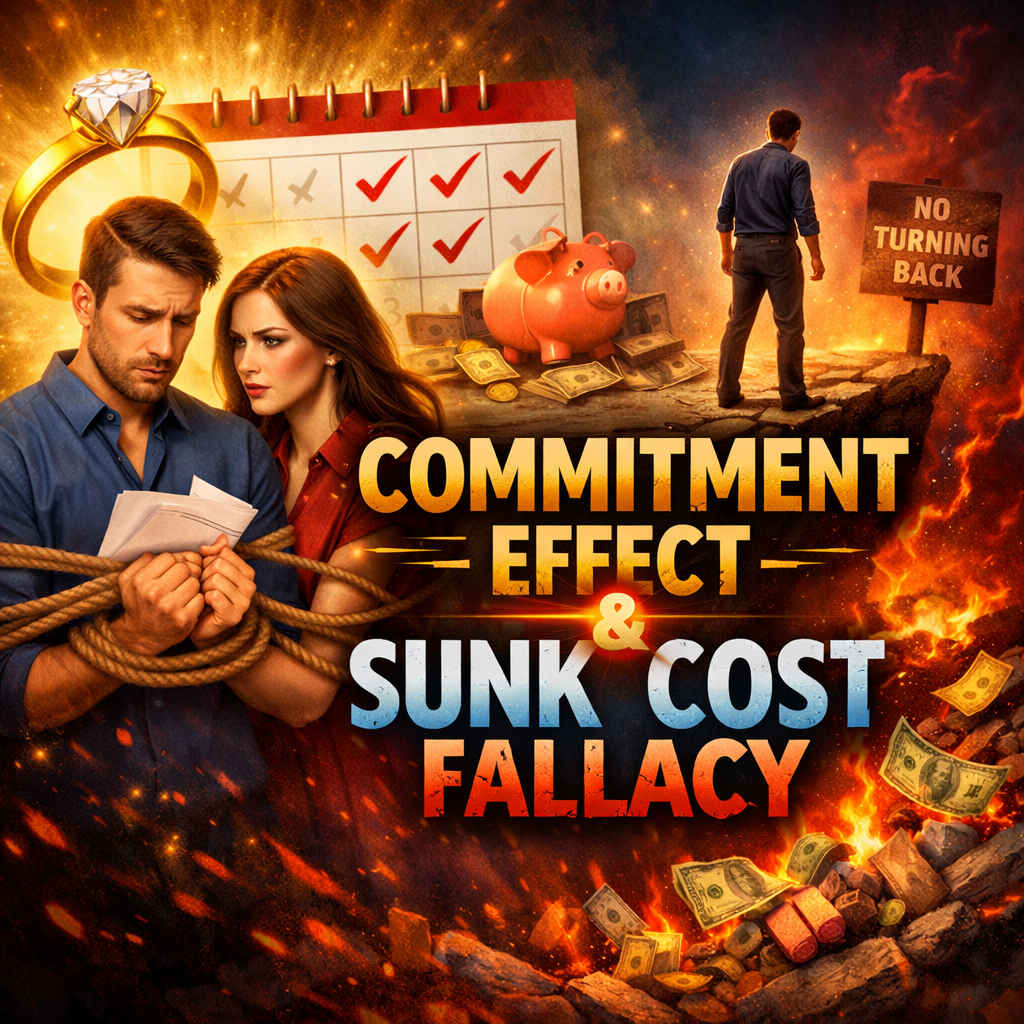
This is where two powerful psychological forces come into play: the commitment effect and the sunk cost fallacy.
Why Our Brains Love Consistency
Human beings naturally strive for consistency.
When our actions align with our previous choices, we feel dependable, confident, and in control. Consistency reinforces our identity and helps us make sense of our decisions.
Changing course, however, can feel uncomfortable.
It forces us to question our earlier judgment, admit we might have been wrong, or explain our decision to others.
To avoid that discomfort, we often continue along the same path.
Not because it's the best decision.
Because it's the easiest one to justify.
The Commitment Effect
The commitment effect is our tendency to remain consistent with commitments we've already made.
Once we publicly commit to a goal, invest effort into a habit, or make a promise, we're more likely to follow through—even when the journey becomes difficult.
This tendency isn't inherently bad.
In fact, it's one of the reasons people successfully build habits, complete degrees, stick to exercise routines, and achieve long-term goals.
A student who tells friends they'll study every evening is more likely to keep that promise.
Someone who commits to running every morning gradually turns it into a habit.
Small commitments often lead to meaningful long-term change.
When Commitment Meets the Sunk Cost Fallacy
The problem begins when commitment is no longer guided by future value but by past investment.
This is known as the sunk cost fallacy.
Instead of asking,
"What's the best decision from this point forward?"
we ask,
"How can I quit after everything I've already invested?"
Money already spent.
Years already invested.
Time already lost.
These are sunk costs—they cannot be recovered.
Yet they continue to influence our decisions.
Commitment vs Sunk Cost Fallacy
Commitment Effect
The commitment effect is about being consistent with a previous commitment.
The internal thought is:
“I said I would do this, so I should follow through.”
Examples:
- I am committed to exercising every day, so I will go to the gym.
- I told everyone I would finish this course.
- I promised my team I would complete this project.
The motivation is consistency.
Sunk Cost Fallacy
The sunk cost fallacy is about past investments.
The internal thought is:
“I have already spent so much that I can't stop now.”
Examples:
- I have spent $5,000 building this app.
- I have been in this relationship for 8 years.
- I have already watched 90 minutes of this movie.
The motivation is recovering or justifying past costs, even though those costs can't be recovered.
How They Work Together
In real life, these two biases often reinforce one another.
Imagine an entrepreneur who publicly announces a startup. Months later, the business struggles.
The commitment effect says:
"I told everyone I would make this work."
The sunk cost fallacy says:
"I've already invested ₹20 lakh. I can't stop now."
Together, these thoughts make it much harder to walk away—even when doing so would be the better decision.
Sunk Cost Trap Is Everywhere
These psychological effects quietly shape many areas of our lives.
Career
A professional realizes they dislike their career after several years but continues simply because they've already invested too much time in it.
Business
An entrepreneur keeps funding a product that customers don't want because abandoning it feels like admitting failure.
Relationships
Someone remains in an unhealthy relationship because leaving would make years of emotional investment feel wasted.
Everyday Life
You order food online.
A few minutes later, you notice dozens of terrible reviews.
Instead of canceling the order, you convince yourself:
The order has already been placed. Canceling now feels like wasting the money, even though canceling may be the better decision.How Businesses Use Commitment
Ever wondered why so many companies offer free trials?
Streaming platforms.
Fitness apps.
Software subscriptions.
Online learning platforms.
The free trial isn't just about letting you experience the product.
It's about encouraging a small commitment.
Once you've created an account, personalized your settings, uploaded your files, or built a routine around a service, leaving becomes psychologically harder.
The initial commitment increases the likelihood of future commitment.
This is one of the most effective principles in behavioral design.
The Psychology Behind It
Several psychological forces make these biases so powerful:
- Desire for consistency: People want their actions to align with previous choices.
- Self-image: Following through reinforces the belief that we are dependable and disciplined.
- Social expectations: Public commitments create pressure to remain consistent.
- Loss aversion: We dislike accepting losses, even when continuing creates larger ones.
- Fear of regret: Admitting a decision was wrong can feel emotionally painful.
Together, these biases make changing direction surprisingly difficult.
When the Commitment Effect Helps
Not every commitment is harmful. In fact, this psychological tendency can be incredibly powerful when directed toward positive goals.
The commitment effect can help us:
- Build healthy habits.
- Stay disciplined during difficult periods.
- Achieve long-term personal and professional goals.
- Honor promises and responsibilities.
- Develop resilience and perseverance.
Many successful people intentionally create commitments—such as sharing goals publicly, hiring coaches, or joining accountability groups—to increase the likelihood of success.
When Commitment Crosses Into the Sunk Cost Fallacy
The commitment effect becomes problematic when our desire for consistency combines with the sunk cost fallacy, causing us to value past investments more than future outcomes.
Warning signs include:
- Continuing to invest in a failing project.
- Ignoring new evidence because it contradicts earlier decisions.
- Staying in situations that no longer align with your goals.
- Making decisions based on past investments instead of future benefits.
At this point, commitment shifts from being a strength to becoming a barrier to better decision-making.
How to Avoid the Negative Side of the Commitment Effect
Awareness is the first step.
Before continuing with any major decision, ask yourself:
- If I were starting today, would I make the same choice?
- Am I continuing because it's still the best option—or because I've already invested too much?
- What evidence would convince me to change my mind?
- Am I protecting my future, or defending my past?
These questions shift your thinking from emotional attachment to rational decision-making.
Final Thoughts
Commitment is a remarkable psychological tool.
It helps us build habits, stay disciplined, and accomplish goals that require persistence.
But commitment should serve our future—not trap us in our past.
Sometimes the bravest decision isn't to keep going.
It's to recognize that the circumstances have changed, learn from the experience, and choose a better direction.
After all:
True wisdom isn't measured by how long you stay committed to a decision. It's measured by knowing when persistence serves your future—and when changing course is the wiser choice.




Join the discussion
Sign in with your account to post comments, reply to others, and participate in the conversation.
Login to Comment