


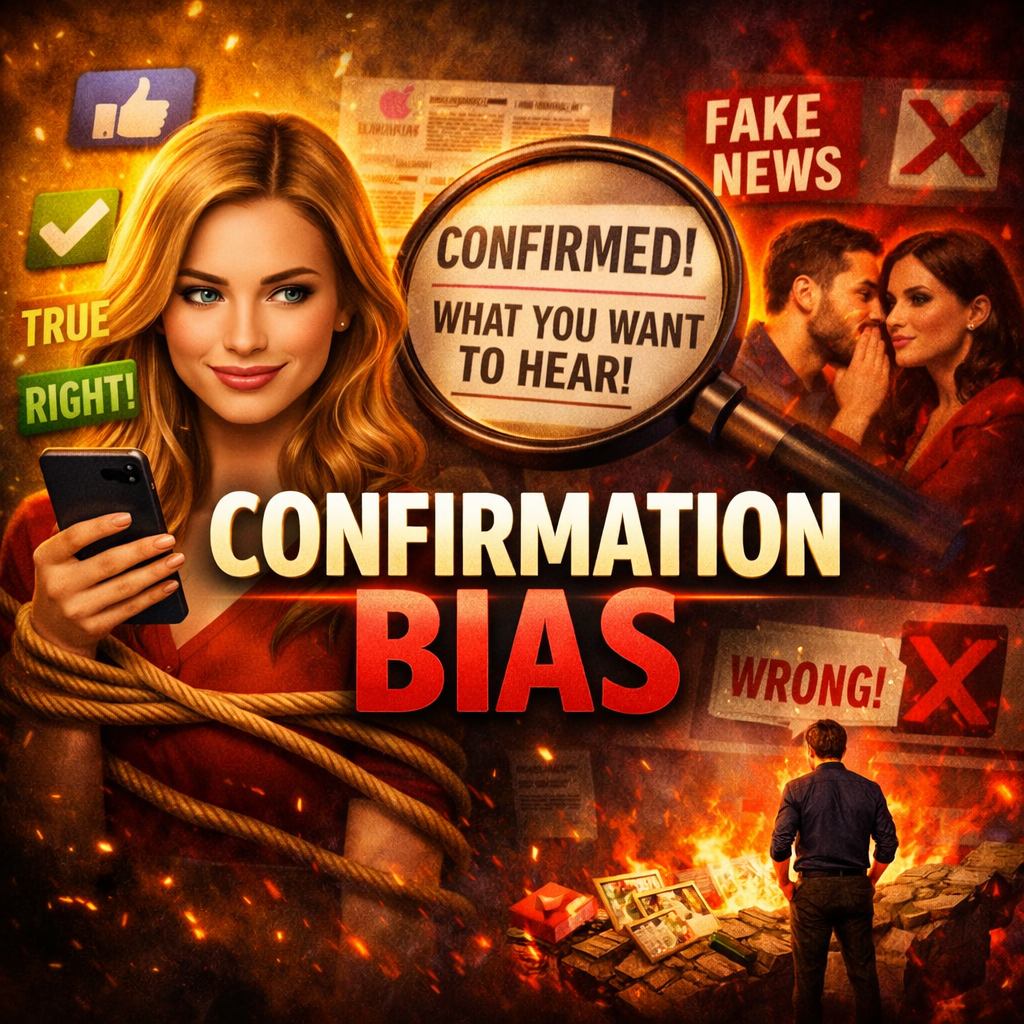
Imagine you are in argument with a friend.
You both pull out your phones.
Not to discover who is right.
But to prove that you already are.
You search for articles, videos, and opinions that support your side while quietly dismissing anything that contradicts it.
By the end of conversation, neither of you has changed your mind.
In fact, you are both more convinced than ever.
This isn't stubbornness.
It's psychology.
Welcome to Confirmation Bias – one of the most powerful cognitive biases shaping the way we think, learn, and make decisions.
Table of contents [Show]
What Is Confirmation Bias?
Confirmation bias is our tendency to seek, interpret, and remember information that confirms our existing beliefs while ignoring or discounting information that challenges them.
In simple terms:
We don't always search for the truth.
We often search for evidence that we are already right.
The bias works quietly in the background.
It influences the articles we read, the people we follow, the opinions we trust, and even the memories we recall.
Why Does Our Brain Do This?
Our brains are designed to make sense of the world efficiently.
Questioning every belief we hold would be mentally exhausting.
Instead, our minds prefer consistency.
When we encounter information that agrees with us, it feels satisfying.
When we encounter information that challenges us, it creates discomfort.
Psychologists call this cognitive dissonance—the mental tension we experience when new information conflicts with our existing beliefs.
To reduce that discomfort, we often reject the new information instead of reconsidering our beliefs.
It's easier to protect our worldview than to rebuild it.
Confirmation Bias Is Everywhere
Once you recognize it, you'll start noticing it in everyday life.
You interact with a few posts about a topic.
Soon, your feed is filled with similar opinions.
Over time, it begins to feel as though "everyone" agrees with you.
In reality, you're seeing a filtered version of the world.
At Work
A manager believes an employee lacks initiative.
After forming that opinion, they begin noticing every missed deadline but overlook the times the employee takes ownership and exceeds expectations.
The original belief becomes stronger.
In Relationships
You believe someone is unreliable.
When they forget to reply to one message, it confirms your belief.
When they consistently support you in other ways, those moments receive far less attention.
Investing
An investor believes a company's stock will rise.
Instead of researching both sides, they spend hours reading optimistic forecasts while ignoring warning signs.
They're no longer gathering information.
They're gathering reassurance.
Why Confirmation Bias Is So Dangerous
Confirmation bias doesn't just influence what we believe.
It influences what we notice.
Once we form an opinion, our brain begins acting like a filter.
Supporting evidence feels important.
Contradicting evidence feels suspicious, irrelevant, or easy to dismiss.
Over time, this creates an illusion that our beliefs are stronger than they actually are.
The result?
We become more confident.
Not necessarily more correct.
How Technology Amplifies It
Modern technology makes confirmation bias even stronger.
Search engines learn what interests us.
Social media platforms recommend content similar to what we've already engaged with.
News feeds show us stories we're more likely to click.
Gradually, we find ourselves surrounded by opinions that mirror our own.
This is often called an echo chamber—an environment where our existing beliefs are constantly reinforced while opposing perspectives become increasingly rare.
The more we hear the same ideas, the more certain they begin to feel.
When Confirmation Bias Helps
Confirmation bias isn't entirely harmful.
It can provide confidence, reduce uncertainty, and help us make decisions without constantly second-guessing ourselves.
Without some consistency in our beliefs, everyday decision-making would become overwhelming.
The problem isn't having beliefs.
The problem is becoming unwilling to question them.
When It Beomes a Problem
Confirmation bias can lead us to:
- Ignore evidence that challenges our opinions.
- Make poor financial decisions.
- Strengthen stereotypes about people.
- Stay trapped in unhealthy beliefs.
- Become polarized in political or social discussions.
- Resist learning from mistakes.
The more convinced we are that we're right, the less likely we are to discover when we're wrong.
How to Reduce Confirmation Bias
No one is immune to confirmation bias.
But we can reduce its influence.
Before making aan important decision, ask youself:
- What evidence contradicts my opinion?
- If I believed the opposite, what arguments would I make?
- Am I searching for answers—or for validation?
- What information would genuinely change my mind?
- Have I considered viewpoints from reliable sources that disagree with me?
These questions encourage curiosity over certainty.
Final Thoughts
Confirmation bias doesn't make us unintelligent.
It makes us human.
Our brains naturally seek consistency, certainty, and reassurance.
But growth rarely comes from hearing what we already believe.
It comes from being willing to question our assumptions, examine uncomfortable evidence, and admit when we've learned something new.
The next time you find yourself searching for proof, pause for a moment.
Ask yourself:
Am I looking for the truth—or am I simply looking for confirmation that I'm already right?





Join the discussion
Sign in with your account to post comments, reply to others, and participate in the conversation.
Login to Comment